
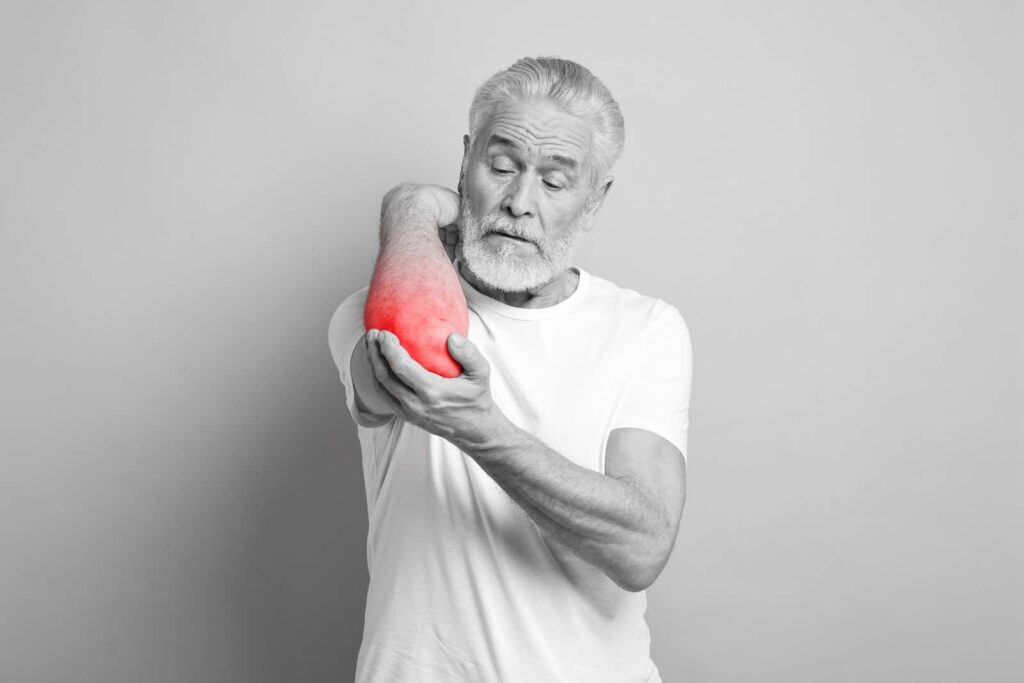
How long does it take to heal golfer's elbow? The time it takes for a golfer's elbow (medial epicondylitis humeri ulnarisWhether the wound has completely healed and is pain-free is one of the most frequently asked questions in our practice. Since in most cases it is a chronic degeneration Since it involves the flexor tendons, a quick recovery is rare. Realistically, the time until the question is How long does it take to heal golfer's elbow? This question has been satisfactorily answered with consistent conservative therapy. six weeks to six months, In complex cases, it can take even longer. This broad timeframe underscores the need for early and highly specialized therapy. In our practice in Frankfurt We rely on a combination of pain management, eccentric training, and ergonomic correction to accelerate the structural regeneration of the tendon and reduce the healing time to the biologically necessary minimum. Success depends significantly on the patient's active participation.
The phases of golfer's elbow recovery
The healing time is directly linked to the consistent implementation of the therapeutic steps and can be divided into three overlapping phases. The transitions between these phases must be carefully monitored by the therapist to avoid setbacks.
- Phase 1: Acute phase (weeks 1–4): Pain and inflammation are reduced through complete rest, cooling, and physical therapy. The focus is on soothing the irritated tendon tissue and passively mobilizing the adjacent joints.
- Phase 2: Development phase (months 1–3): Start of targeted eccentric strengthening training. The load is gradually increased to strengthen the tendon structure. During this phase, ergonomic consultation is also intensified to eliminate the cause of the overuse injury.
- Phase 3: Regeneration phase (months 3–6+): Increasing resilience to the level before the illness, full resumption of sporting/professional activity and establishment of a lifelong prevention program.
Why does the healing process take so long?
The answer to How long does it take to heal golfer's elbow? lies in the Biology of tendons. Tendons are, due to their small size, Vascularization (Poor blood circulation) relies on a slow metabolism and a lengthy repair process for damaged tissue. The chronic nature of the condition—often resulting from months of microtrauma—necessitates a complete remodeling of the inferior tendon tissue into resilient, functional connective tissue. This remodeling process is time-consuming. Premature or excessive stress would immediately interrupt this process and prolong the healing time. Consistency in training is the only way to optimize this timeframe.
Prognostic factors and therapeutic interventions
The individual prognosis, how long it takes for golfer's elbow to go away, It is influenced by various factors. However, therapeutic interventions can positively influence these factors by specifically supporting the healing mechanisms.
Prognostic factor | Positive influence through hand therapy |
Duration of symptoms | Immediate start of therapy to prevent chronicity |
Consequence of the training | Development of a customized, motivating home program |
Occupational stress | Targeted ergonomic adjustments to the workplace in Frankfurt |
Physical fitness | General strengthening and stretching exercises for the upper body |
Psychosocial factors | Pain management and stress reduction counseling |
The role of eccentric training in the healing process
The eccentric training is the crucial catalyst for the answer to How long does it take to heal golfer's elbow?. It is the only non-invasive method that can do this. tendon tissue At the cellular level, it challenges the body to structurally regenerate. Activating the muscle while simultaneously stretching it (the eccentric phase) stimulates blood flow, optimizes collagen production, and... Tensile strength The tendon is increased. The correct dosage and technique are of utmost importance. Frankfurt Learn to perform the exercises in such a way that the necessary stimulus for healing is provided without triggering renewed inflammation, which would delay the entire healing process.
Frequently asked questions about the healing time of golfer's elbow (FAQ section)
1. How long will it take before I feel the first improvement in my golfer's elbow?
A first significant pain relief during golfer's elbow can often be done after two to four weeks Consistent rest, cooling, and the start of stretching exercises will lead to improvement. However, this is only the beginning. The actual structural healing and strengthening of the tendon takes considerably longer.
2. Can I shorten the healing time of golfer's elbow with medication?
Medications (such as NSAIDs) can relieve pain and reduce inflammation during the acute phase. shorten the healing time However, not directly, as they do not reverse the tendon degeneration. The most important and sustainable measure that shortens the duration is the consistent eccentric training, which you will achieve through your therapy in Frankfurt learn.
3. What prolongs the healing time of golfer's elbow the most?
The healing time of the Golfer's elbow is most strongly influenced by Premature resumption of pain-inducing activities and the Neglect of the home program prolonged. Even constant, minor overuse in everyday life (e.g., due to ergonomic errors) prevents tendon regeneration and delays the response to How long does it take to heal golfer's elbow? unnecessarily long.
4. Will golfer's elbow go away faster if I get a cortisone injection?
Cortisone injections can relieve the pain during golfer's elbow The symptoms disappear very quickly (within a few days). However, this does not mean that the arm is healed. Studies show that while cortisone quickly suppresses the symptoms, it often leads to long-term problems (after 6–12 months). worse results It provides more benefits than pure physiotherapy/occupational therapy. It often delays the necessary structural healing.
5. How long do I have to take a break from sports until my golfer's elbow goes away?
The length of breaks during sporting activities depends heavily on the sport. In golf or tennis, a break can last from several weeks to months This may be necessary. The return to sport should be gradual and only occur once you have completed eccentric training. pain-free You can perform the exercise and your muscles have been stabilized accordingly.
6. What happens if golfer's elbow is still not gone after 6 months?
If the golfer's elbow If pain persists after six months of intensive conservative therapy (including occupational therapy, training, and ergonomics), it is referred to as a therapy-resistant, chronic condition. In this case, further options such as shockwave therapy or, in rare cases, surgical decompression must be considered.
7. Can professional occupational therapy in Frankfurt shorten the duration?
Yes, specialized occupational therapy in Frankfurt can shorten the duration of the illness, as it is based on evidence-based protocols how eccentric training sets and simultaneously the individual causes of overload It eliminates these issues in your daily life. Instructions for correctly performing the home program are essential and prevent errors that would prolong the healing time.
8. How long do I have to wear the epicondylitis brace until the golfer's elbow is gone?
The brace serves to Relief during painful activities. The duration of wear is not fixed but depends on the symptoms. As long as you find certain movements painful, the brace should be worn. However, it can be removed once the pain is permanently controlled by the strengthened tendon tissue.
9. Is the healing time for tennis elbow (outer side) different from that for golfer's elbow (inner side)?
The healing time for tennis elbow and golfer's elbow comparable (usually several months). Both are tendinopathies that require slow recovery. Tennis elbow tends to be perceived as somewhat more persistent in some cases due to its more frequent occurrence among tradespeople and the greater strain they face in daily life.
10. Do I need to be completely pain-free for a full recovery?
For full recovery of strength, the hand and elbow must be treated. largely pain-free This is especially true during everyday and sporting activities. A slight pulling sensation during eccentric training is often tolerable in the initial phase, but severe pain (grade 5 or higher on the pain scale) should be avoided to prevent disrupting the healing process.

 English
  German